WWD, August 2026
How Gucci Westman and David Neville are Defying Conventional Wisdom to Build a Brand for the Ages
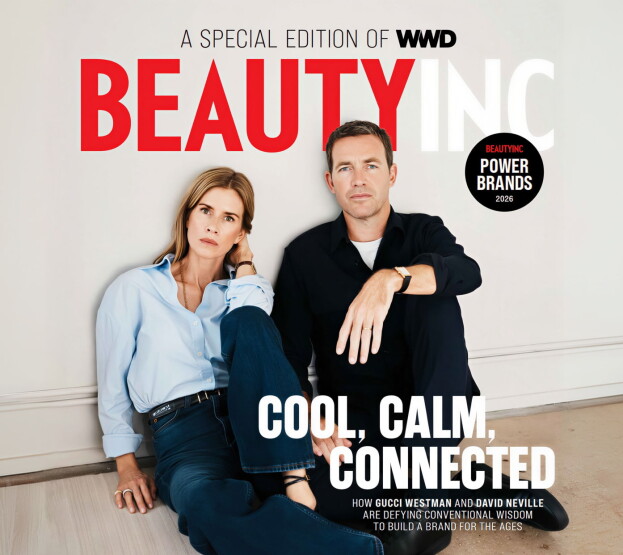
At a time when there have never been more brands, Gucci Westman and David Neville have cracked the code on how to build a business for the ages.
When Westman Atelier unveiled Suprême Bio-Complex, its first liquid foundation, this July, it wasn’t just another stock keeping unit — it was a demonstration of the painstaking product philosophy that has helped turn the eight-year-old brand into an indie phenom.
The product was originally slated to launch in 2025, but brand founder and famed makeup artist Gucci Westman put the kibosh on that plan. Even though the company’s strategy called for it to be the biggest launch to date in brand history — conventional wisdom holds foundation is the number-one product to engender customer loyalty and repeat purchases for a makeup brand — Westman wasn’t content with the formula.
“It simply wasn’t good enough,” said Westman, “so we started over again.” Many brands, particularly in today’s ever-more crowded and competitive makeup environment, might have launched anyway. But cultivating consumer trust, as opposed to pursuing rapid product expansion and chasing virality, has become a defining — and differentiating — aspect of Westman Atelier’s go-to-market model.
Call it the most considered approach in beauty. “Slow and steady is not the right term, because it underplays the growth trajectory we’ve had,” said David Neville, Westman’s husband and cofounder and chief executive officer of the brand. “But at the same time, it’s not a viral curve, which is not something that we would want either.”
The growth trajectory Neville talks about — industry sources estimate that Westman Atelier will reach $100 million in net revenue this year — has not gone unnoticed by the industry.
Almost since its inception, Westman Atelier has been a hot commodity and the subject of speculation regarding a potential acquisition. In 2019, the brand received a minority investment from Prelude Growth Partners. Earlier this year, it was reported that it raised $15 million from existing backers Imaginary Ventures and Prelude Growth Partners.
One banking source speculated that it will be one of three of today’s makeup brands that will eventually find a home with a strategic, even though for now the deal appetite in beauty appears to be more focused on fragrance and wellness. Indeed, there hasn’t been a major strategic acquisition of a prestige makeup brand since the Puig/Charlotte Tilbury deal in 2020.
“We truly believe that we have the opportunity to be a leading global luxury beauty brand,” said Neville. “We’ve laid some extremely good foundations.”
Among the brand’s achievements: Global distribution that includes more than 1,000 doors in the U.S., Europe and Australia, but ample room to expand in Asia and the Middle East. “We’ve been intentional with how we’ve expanded,” said Neville. “From a geography perspective, there’s a lot of room to expand. From a category perspective, we’re working on some exciting new categories.”
While Westman and Neville have said they’re not in a rush to sell, they’re not saying no, either. The question seems to be when, rather than if. “It’s quite hard to be an independent global luxury player. That’s a very honest and transparent answer,” said Neville. “The brand itself is so strong that when the timing’s right, we’d be really excited to be part of the right global strategic, because they could do a lot with what we have and we could really benefit from those kinds of resources that would enable us to be quicker and reach a bigger audience.”
(On whether they find those persistent rumors that it could eventually end up at a particular strategic annoying, they do not. “It’s a compliment, honestly. It’s kind of like being courted a little bit,” said Westman. “It’s charming.”)
Westman Atelier has achieved a lot on its own, rising to the top of the ranks in complexion and lip and building out multiple hero skus. “Across the assortment, complexion products remain particularly strong, with the Contour, Blush and Highlight sticks serving as fan favorites,” said Amy Abrams, senior vice president of makeup merchandising at Sephora, who noted that Hydrobalm Lipstick has become one of the top-selling lipsticks chain-wide. “We’re especially excited about the foundation launch, which we believe has the potential to break through in an incredibly competitive category.”
“What we consistently hear from customers is that Westman Atelier delivers their best skin, not a made-up look,” agreed Rachel Eichen, vice president and divisional merchandise manager of beauty at Nordstrom. “It’s a brand that turns everyday application into an experience, and that’s why it continues to be a standout in our beauty portfolio.”
Westman Atelier’s product ethos reflects the sensibility of Westman, a makeup artist whose starry client list includes Anne Hathaway, Cameron Diaz and Nicole Kidman and who herself has become a celebrity of sorts, counting almost 500,000 followers on Instagram, where she shares snaps of her chic life, from equestrian shows with her daughter Gray to tutorials to GRWM videos.
“The brand sits at the rare intersection of the credibility of a working makeup artist brand but with celebrity cachet,” said Cassie Cowman, cofounder of the beauty consultancy View From 31. “Gucci has such a distinct personality. It has enabled her to have both expert and aspirational luxury positioning.”
That star quality, coupled with the quality of the products, has helped the brand grow beyond just its famous cofounder. “Gucci herself has that halo, because of her artistry, her lifestyle, her kindness, her values,” said a source who spoke on the condition of anonymity. “I think the portion of consumers who know Gucci and follow her is a relatively small portion of the total brand. It was higher at the beginning, but as the brand has scaled, it has grown much beyond her as a person and an artist.”
The numbers bear out that idea. While many indie brands are content with one or two signature products that may account for north of 50 percent of their business, Westman Atelier has five or six that contribute double-digit penetration to the total brand. The brand has broad versatility in terms of its bestsellers, its channel network and its demographic reach.
Key retailers include specialty stores and luxury department stores. “While the channel’s been more challenged for quite a long period of time, it’s still a significant opportunity from a revenue perspective,” said Neville, of the latter. “We can sit next to true luxury houses in luxury department stores and perform extremely well, and we can sit in specialty retail like Sephora or Space NK where it’s a bit more of an even playing field and perform extremely well there, too. The brand can flex across different retail formats.”
The same holds true for its audience, which has evolved organically over time. “There were so many brands that were launching for Millennials and Gen Z, and we were not shy about the fact that we were targeting Gen X,” said Neville. “But what’s transpired is that it’s actually much more cross-generational. We can engage with customers in different ways, whether that’s through the mini size of our hero contour stick, which is a huge sku at Sephora, or through some of our skin care products. It’s an incredibly important aspect of how we are able to continue to grow at the rate that we are because you can’t be too pigeonholed or too niche in the way that you’re talking to your customer.”
“If the product and the performance resonate with people, it’s not an age thing,” added Westman. “We’re focusing on the product.”
During their 20 year-marriage, Westman and Neville previously collaborated on projects together, but this is the first time they have had a business together. While it’s not for everyone, they believe their mutual trust and respect as well as always having defined roles are key ingredients of their secret sauce.
“It was definitely quite risky to, as a husband and wife, decide to do this, but at the same time, we did have the skill sets that really gave us a good chance of being successful,” said Neville. “We complement each other very well.”
“Recently we were at David’s 50th, and I was seated next to somebody who said, “How do you find working with your husband?” Westman recounted. “And I said, ‘I mean, it’s great. It’s actually so smooth and so intuitive, and it’s rooted in so much trust and respect.”
“Our roles are so defined, and we have always had the same aesthetic vision.”
That includes realizing the dream of establishing Westman as a true lifestyle brand, not just beauty. “Gucci’s world is something that we know customers are interested in,” said Neville. “A lot of customers are very intrigued with what Gucci wears and her lifestyle outside of just cosmetics. That’s not something we’re immediately focused on. But there’s a world around Westman Atelier and Gucci where ultimately, we can decide to launch different types of product categories.”
In the nearer term, skin care and fragrance are top of mind. “We have some phenomenal products coming,” said Westman, “and another obsession I have is fragrance, which is potentially in the works.”